
Meter
See where
the power goes.
Put PM-2 between a charger and a device. Volts, amps, watts and the energy delivered, on one small screen. Reading the deal the two agreed is drawn in too, and not yet proven.
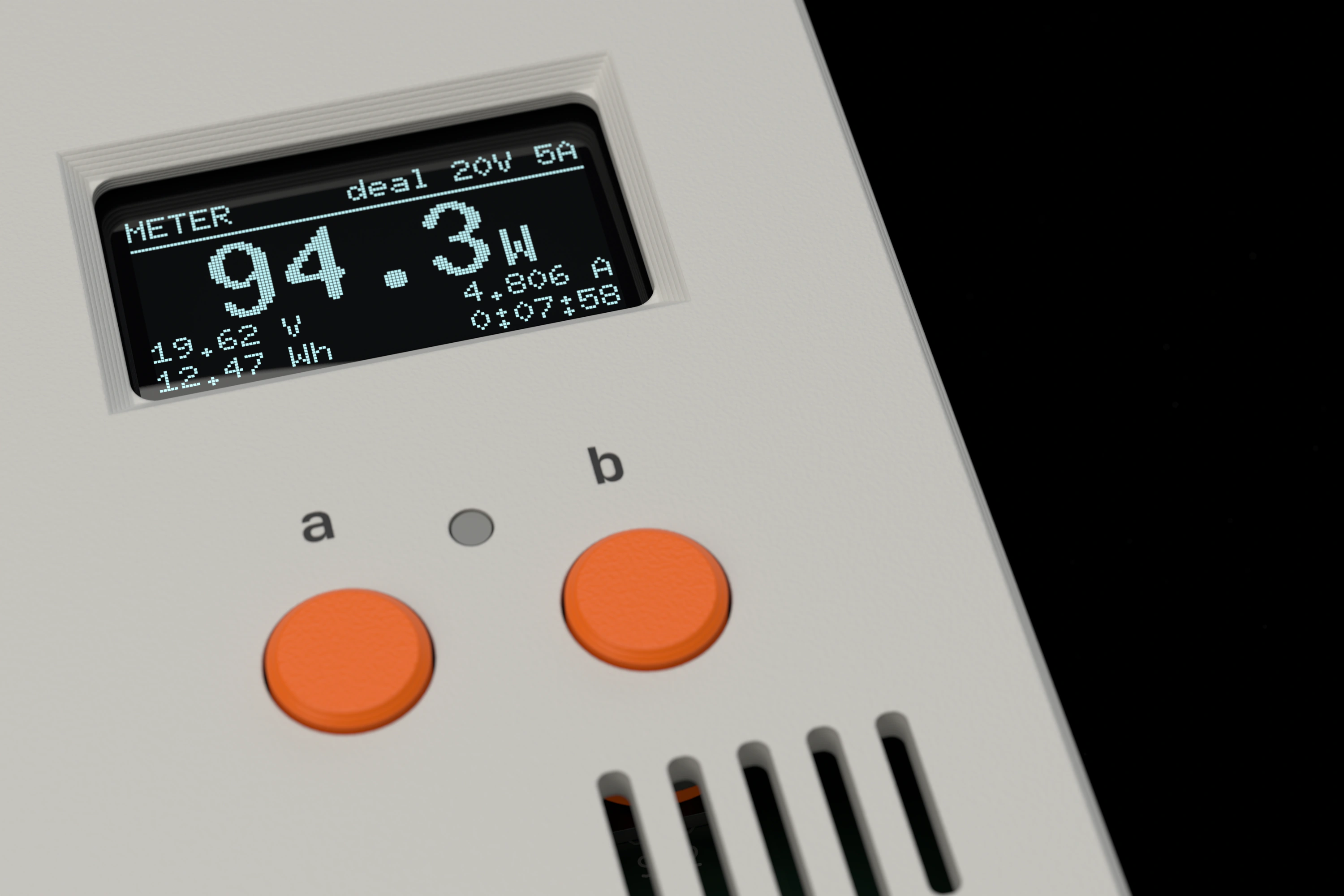
94.3W
19.62 V × 4.806 A
Cable test
Good cable.
Bad cable.
Know which is which.
Plug in both ends of one cable. PM-2 is designed to check all 24 contacts, measure the power and ground wires and read the cable’s chip, then call it good, fair or bad.

Good

0.50 V
lost at 5 A. All wires present. Chip read.
Fair

0.63 V
lost at 3 A. Charges. USB 2 data only.
Bad

1.20 V
lost at 3 A. Power wires only.
USB-A to USB-C cables too, down to the small resistor that tells a phone how much it may draw.
Charger check
Ask a charger
what it can do.
Plug in a charger on its own. PM-2 lists every voltage and current it offers, through the cable you use.

100 W
Five offers, from 5 V up to 20 V at 5 A.

Designed around the cables you already own.
Design
Six sockets.
Two edges.
Two buttons.
The meter on the far edge. The cable test on the near one. One button switches between them. The other turns the page.


6
sockets: five USB-C, one USB-A
128 × 64
pixels, behind black glass
106 × 76 × 22
millimetres: the case, as drawn
Inside
Four layers of copper.
Four power monitors.
A 100 × 70 mm board fills the case. The current between in and out runs through a 5 mΩ shunt, and the cable test has its own load.

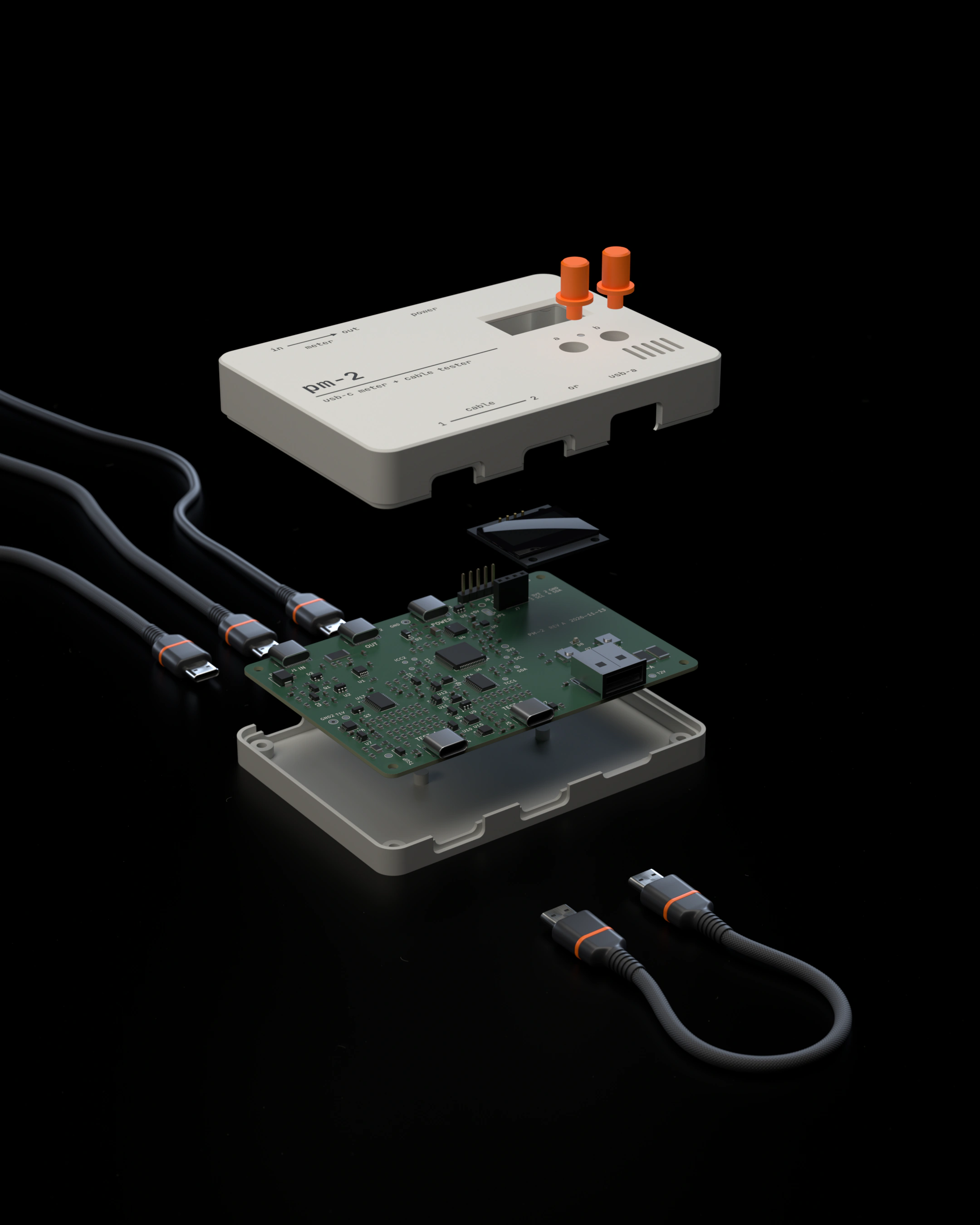
Lid. Display.
Board. Tray.
Two button caps sit in the lid. Drawn to be 3D printed and held together by four screws from below. None has been printed yet.
The design,
in one minute.
A render of the design, cut to “Odyssey” by John Tasoulas.
Specs, as designed
- Designed for
- Up to 48 V and 5 A, through the meter
- Meter
- Volts, amps, watts, energy and time
The deal the charger and device agreed (drawn in, not yet proven) - Cable test
- All 24 contacts of each USB-C test socket
Power and ground wire resistance
The cable’s chip, if it has one
The resistor in a USB-A to USB-C cable - Charger check
- Every power level a charger offers, with no load
- Display
- 128 × 64 pixels, behind black glass
- Sockets
- Five USB-C: in, out, power, 1, 2
One USB-A - Buttons
- Two: a turns the page, b switches between meter and cable test
- Board
- 100 × 70 mm, four copper layers
Four power monitors, 5 mΩ shunt - Case
- 106 × 76 × 22 mm, drawn to be 3D printed
- Status
- Draft A, on paper. Not built, not tested, no firmware yet
Plug it in yourself.
The 3D page puts PM-2 on your screen. Plug in a cable, press a button, look inside.